2023 European Games confirmed as Paris 2024 qualifer for Breaking

Breaking has revealed its continental qualifier for three continents including Europe.

Breaking

Each qualifier will earn a place for both events (i.e. one per gender), with the champion (or vice-champion if the champion had already got a place from the 2023 Worlds) of each continental qualifier making Paris 2024. Europe’s qualifier has been announced as the 2023 European Games (Krakow, POL, 21 Jun-2 Jul). The chances of us qualifying a place are massively slim but to win a gold medal at the European Games is even slimmer.

Qualification for Paris 2024 is underway with qualification for every sport apart from Athletics and BMX Freestyle Cycling revealed.

Aquatics adds to Paris 2024 qualification procedures

The qualification systems for the disciplines of Artistic Swimming, Diving, Marathon Swimming, Swimming and Water Polo, together making up the sport of Aquatics, have been released.

Artistic Swimming

Artistic Swimming is a women’s only discipline, with a reduction from 104 to 96 women competing, down from Tokyo 2020,. There are still two events: Teams and Duets. A duet consists of two athletes, while a team consists of eight. Just like 2020, there will be ten teams, at most one per country. The host country will automatically gain a spot, while the winners of Continental Championships gain a spot for each continent apart from Europe (as France automatically take the European continental spot. The other five places will be earned at the 21st FINA World Championships (Doha, QAT, 2-18 Feb 2024). This means that there is no longer a separate qualification event. GB did not qualify for the event in 2020, but in the recent World Championships the team did come 12th, although there was no French team. If Russia and Belarus are still absent, it will help GB’s outside chances of getting a team.

For the duets, there will now be 18 pairings, down from 22. The ten teams will automatically qualify a duet, and the two athletes in the duet must also be part of the team. Again, the winners of Continental Championships will earn a spot. Technically, the European spot should go to France, but as they will have already qualified from the Team competition there will also be a European event. The final three places will be earned at the 21st FINA World Championships. Again, this means the end of the qualification event. GB qualified in 2020 and it’s a very realistic target to do so again.

Diving

Diving has Individual and Synchronised 3m Springboard and 10m Platform events for both gender and 68 athletes per gender, this represents no change from 2020. In individual events, there are at most two places per NOC, but each individual athlete can only earn one place. The top twelve athletes at the 2023 FINA World Championships (Fukuoka, JPN, 14-30 Jul 2023) will qualify a place. The winners of Continental Championships will also qualify a spot. In this event, only the winners will qualify a place; if the winner has already qualified the place will be reallocated to the next qualification system. This is the 21st FINA World Championships, which will qualify twelve places plus any additional places. Extra places may also be added at this event in the case that the total quota of 136 places is for some reason not met. For the team events, there will be eight teams per event (one per country). The top three teams at the 2023 FINA World Championships, the top four at the 21st FINA World Championships, and the host country will be the eight teams. With two world championships during the cycle, the FINA World Cup has been replaced, but otherwise the system is mostly similar form 2024. In 2020, GB qualified a full set and should target doing so again. Any struggle to do so will probably come from the women’s side of the competition.

Marathon Swimming

In Marathon Swimming, there are 10km events for both genders, but there will now be 22 athletes per gender (at most two per NOC), down from 25. The qualification system is the same for both genders. Three athletes per gender will qualify a spot at the 2023 FINA World Championships, while the top thirteen athletes per gender from the 21st FINA World Championships will do the same. Each individual athlete can only earn one place at the Games. Then, the highest athlete left from each continent at those championships will also gain a place. Finally, there is a host country quota. Again, there is no longer a specific qualifier, instead the two world championships both earn places. GB qualified one athlete per gender in 2020 and it is not an unrealistic thing to expect the same in 2024.

Swimming

Swimming has a total of thirty-five events. For both men and women, there are seventeen events: for Freestyle; 50m, 100m, 200m, 400m, 800m, and 1500m; for all of Backstroke, Breaststroke and Butterfly; 100m and 200m; a 200m and 400m event for Individual Medley, both 4x100m and 4x200m Freestyle Relays and a 4x100m Medley Relay. The thirty-fifth event is a mixed 4x100m Relay. There are 426 athletes per gender, down from 439 in Tokyo. In each indvidual event, there are at most two athletes per NOC, and at most one relay team per NOC. In individual events, hitting the Olympic Qualification Time (OQT) in FINA-approved events (1 Mar 2023-23 Jun 2024) will earn you a pathway in automatically. But there is a complicated medley of alternative ways to qualify. One can qualify by universality invitation (if an NOC qualifies no athlete, they can enter one man or one women as long as they participated in either the 2023 or 2024 World Championships), or being part of a relay team. If you meet the easier Olympic Consideration Time (OCT). One athlete per event will be invited based on the OCT until there are less than 28 places (or one per event) left. For the remaining 27 (or less) places, who gets the nod will be based on World Ranking.

In the Relay, each event will have sixteen teams. Three teams will qualify from the 2023 FINA World Championships and thirteen will qualify from the 21st FINA World Championships. This will allow two additional athletes per relay entered per country, at most twelve. This system is a slight modification from the 2020 system, basing the spots on the Worlds only. GB qualified a big Swimming team in 2020, and no less will be expected in 2024.

Water Polo

Water Polo maintains its 12-team men’s tournament and 10-team women’s tournament from 2020. A team consists of eleven members, and there is at most one team per NOC per event. Two teams will qualify from the 2023 FINA World Championships. The hosts will qualify, with five places (one per event) being earned at Continental Championships (dates and locations TBC). The final four men’s spots and the final two women’s spots will be earned at the 21st FINA World Championships. The FINA Word League is gone as a qualifier, and like other events the dedicated qualifer is replaced by the extra World Championships. GB are not really a serious contender in Water Polo.

Only Athletics and BMX Freestyle (a discipline of Cycling) are yet to release their systems.

Table Tennis, Football receive Paris updates

Paris 2024 has nearly got a “full set” of qualification procedures, and Table Tennis is the latest sport to release its system. Football has also received an update.

Table Tennis

Table Tennis maintains the same programme from 2020: a singles event for both genders, a team event for both genders, and a mixed doubles event. The quotas are also unchanged, with 86 men and 86 women. Each country can have two athletes per singles event, and one team of three or mixed doubles pairing in the other events. In total, this represents three men and three women as a maximum over the programme. Out of the 86 quota spots per gender, three are reserved for the hosts and one for universality places.

For the team event, there will be sixteen teams per gender. Six teams, including one from Europe, will qualify throug a continental qualification event (dates and locations TBC), while the quarter-finalists from the 2024 World Teams Championships (16-25 February 2024, Busan, KOR) will also snag a quota. The highest ranked team not already qualified in the 2024 World Team Ranking (published immediately at the end of the WTC) will also qualify. Finally, the host nation will also qualify a place (unless already qualified in which the place will be reallocated to the ranking).

For the mixed doubles, again there will be sixteen pairs. Again, six will qualify from continental qualification events (including one from Europe), while the semifinalists at a Designated Qualification Event (exact dates and locations TBC) at March or April 2024 will also get a place. The five highest ranked pairs in the Mixed Doubles Ranking of 7 May 2024 will also get a place, as will the hosts France (if they have already qualified a sixth pair will get the spot). A Mixed Doubles member must also be part of the Team if an NOC qualifies athletes in both the Mixed Doubles and the Team event for the relevant gender.

For the singles event, the sixteen teams will see their two highest members based on the World Ranking of 18 June 2024 qualify a place, for a total of thirty-two. Twenty-two places will be won by continent, by Continental Qualification Events (exact dates and locations TBC) that will be held in early May 2024, including six from Europe. Mixed Doubles athletes will also be able to enter, and then fifteen (less the Mixed Doubles athletes) will qualify through the Singles World Ranking of 18 June 2024. Finally, one universality place will be added.

This system is very similar to 2020, where we qualified two men’s singles athletes and one women’s singles athletes, sneaking in by world ranking. A repeat of that would be a realistic target in 2024.

Football

Included for completion’s sake, football has updated its system to include the Asian qualifiers and the Women’s South American qualifiers. Still no news on Europe.

These updates mean that only Athletics, Aquatics, and BMX Freestyle (a discipline of Cycling) are left.

Taylor-Brown the hero as GB get the job done in Montreal

Great Britain have officially qualified for the Paris 2024 Olympic Games, with two men’s triathlon spots, two women’s triathlon spots, and one mixed relay team.

The winner of Sunday’s World Triathlon Mixed Relay Championships were to win two quota spots for each gender, enough to make the Mixed Relay event in Paris. Frances as hosts already had these quotas, so if they were to win the race the places would instead go to the runner-up. With at most three athletes per gender qualifying for the individual events per country, all countries with at least two per gender will automatically enter the mixed relay. There are also eleven specific mixed relay spots, that will automatically qualify two men and two women for the Olympics, and the second of these (after the host spot) was up for grabs in Montreal, Canada on Sunday.

The British team were the pre-race favourites with Alex Yee, Sophie Coldwell, Samuel Dickinson and Georgia Taylor-Brown. Yee and Taylor-Brown won the individual events, with Coldwell also placing high: Dickinson was the odd one out but this was a great experience for him. There was a big pack initially: sixteen teams started (Belgium were non-starters) and this remained through the first swimming and running portion, but Yee managed to lose most of the pack in the run, with just Hayden Wilde of New Zealand staying with him. But the Brazilian, French, and Australian teams managed to catch up in the second swim, with Coldwell leading. However, the chasing pack managed to catch up, and in the end Denmark managed to join France in the lead going into run three. Dickinson’s inexperience showed somewhat as he earned a ten second penalty for missing the box with his helmet, and with France twenty seconds clear of the chasing pack there was no doubt who the winner would be. This pack contained New Zealand and the US, with a second pack of GB, Canada, Denmark and Switzerland eight seconds behind but losing ground despite Dickinson’s best efforts. In the final handover, France were nineteen points clear of NZ/the US, while the other group including GB were sixteen points clear.

But they didn’t have Georgia Taylor-Brown.

France were uncatchable, and Taylor-Brown was 52 seconds off the pace. But New Zealand’s Nicole Van Der Kaay had lost a bit of ground to Summer Rappaport of the US in second, and Taylor-Brown had her first target in sights. As they cycled, she caught up to them, and now the two-woman race for silver was a three-woman race. But she still had the ten second penalty to contend with. She needed to find twelve or so seconds on the run to be sure. After all that hard work, against two other world class triathletes.

But find it she did. Van Der Kaay tried to go with her, but she ran out of steam and Rappaport, who had stayed back, was a bigger threat: slow and steady wins the race, and all she needed to do was be within ten seconds of Taylor-Brown. But as she slowed down in the penalty box, it was clear that GTB had judged it to perfection. While France took the win, Britain came home in second and had booked their place in the Olympics. It was a brilliant performance, with the US getting the bronze medal.

The British team were over the moon. Yee said “It’s amazing, I am absolutely over the moon to share with these guys. To have such a good result, it’s been a long weekend honestly but what a dream way to finish it.” Coldwell added “I think when it’s for your team you always find that little bit extra. Like Alex said, it’s been a tough couple of days of racing and just really proud of everyone for rallying and getting another great performance out.”

Dickinson was apologetic for his mistake, stating: “Obviously being on a team with these superstars it’s always hard to sly in. I didn’t make it easy for G, I might need to buy her a pair of sunglasses or something but I am so thankful, she’s such a superstar and managed to bring it home.” ‘G’ referring of course to Taylor-Brown, who admitted “I really wasn’t sure, I was kind of settling for fourth place as Van Der Kaay and Summer would outrun me because I worked really hard on the swim and the bike. I was using some very strong curse words for little Samuel on that race there but I am glad we got there in the end!”

Dickinson shouldn’t feel too down though as it is a great experience with a big set of events coming up. A silver medal is worth a million pairs of sunglasses.

At most three men and three women can qualify for triathlon. With two of each gender now achieved, we just need one more place per gender to qualify. Keep your eyes peeled on the World Triathlon Individual Olympic Qualification Ranking, which tracks athletes from 27 May 2022 to 27 May 2024.

GB hope to snag early Triathlon quota in Montreal

Great Britain have a great chance to officially qualify their first athletes to the Olympic Games in Paris at today’s World Triathlon Mixed Relay Championships. The triathlon has three events: a men’s event, a women’s event, and a mixed relay event. All countries that enter at least two men and at least two women will automatically be entered into the mixed relay. However, nine countries will qualify directly for the mixed relay, as qualifying through these events will earn quotas for two men and two women. One of those nine special mixed relay spots has been taken by hosts France, but the next one is to be decided later today. The winner of the 2022 World Triathlon Mixed Relay Championships in Montreal, Canada will earn two male and two female quotas at the Games. If France, who have already qualified win, then the spot will be given to the runners-up instead.

Great Britain are the Olympic champions and have to go in to this race as favourites. Our team came second in the race in Leeds, although the winners there, Germany, are not entering this time. All teams in this event start with a man, then have a woman, then a man, and then a woman (MFMF). To lead-off we have Alex Yee, who won gold in the individual event and was also in the Olympic-winning team. Sophie Coldwell goes next: she came 7th in the individual event and was part of the team that won silver in Leeds. Samuel Dickinson is on ranking a weak link, having come 56th in the individual event out of 57 finishers, and having the least experience out of the quartet. Finally, Georgia Taylor-Brown won gold in the individual event, her second win of the World Triathlon Championship Series (WTCS) in the third race, having been in the Olympic-winning team too.

GB won’t have it all their own way however. France aren’t a factor in Olympic qualifying but they came third in Leeds and in the Olympics, with their team including Pierre Le Corre (who came 7th in the individual event), U23 World Champion Emma Lombardi, Vincent Luis (who came 6th in the individual event) and individual silver medallist Cassandre Beaugrand. Another strong team is the US, who won Olympic silver but had a poor showing in Leeds, coming ninth. Their women are the strong link, with Summer Rappaport and Taylor Spivey managing fifth and sixth in the individual event.

That said, GB have to be heavy favourites to win gold and qualify for the Olympics. Regardless of our performance today, it is very likely that we qualify a full compliment of three men and three women in this sport, but this would be a good start.

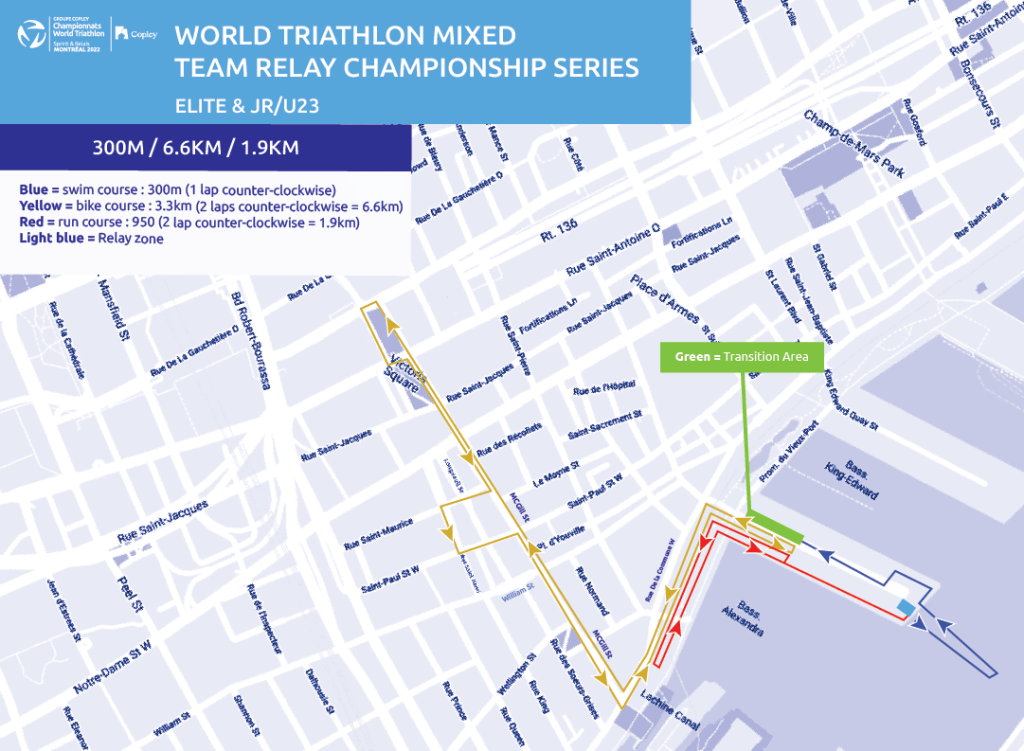
All four athletes will have to swim 300m, cycle 6.6km, and run 1.9km

The full entry list of countries, their athletes and their 2022 WTCS ranking is as follows (correct subject to late changes):
Australia: Jacob Birtwhistle (32), Jaz Hedgeland (35), Brandon Copeland (17), Natalie Van Coevorden (13)
Belgium: Jelle Geens (5), Valerie Barthelemy (45), Marten Van Riel (11), Hanne De Vet (86)
Brazil: Miguel Hidalgo (13), Djenyfer Arnold (23), Manoel Messias (36), Vittoria Lopes (60)
Canada: Tyler Mislawchuk (29), Emy Legault (29), Charles Paquet (24), Dominika Jamnicky (70)
Denmark: Emil Holm (37), Alberte Kjær Pedersen (15), Oscar Gladney Rundqvist (unranked), Anne Holm (96)
France: Pierre Le Corre (3), Emma Lombardi (26), Vincent Luis (6), Cassandre Beaugrand (3)
Great Britain: Alex Yee (9), Sophie Coldwell (6), Samuel Dickinson (63), Georgia Taylor-Brown (1)
Italy: Nicolò Strada (unranked), Bianca Seregni (unranked), Gianluca Pozzatti (49), Carlotta Missaglia (80)
Japan: Takumi Hojo (16), Yuka Sato (68), Kenji Nemer (14), Hikaru Fukuoka (unranked)
Mexico: Irving Perez (101), Lizeth Rueda Santos (67), Rodrigo Gonzalez (89), Anahi Alvarez Corral (88)
Netherlands: Richard Murray (22), Rachel Klamer (17), Mitch Kolkman (92), Barbara De Koning (62)
New Zealand: Hayden Wilde (2), Ainsley Thorpe (40), Tayler Reid (48), Nicole Van Der Kaay (24)
Norway: Vetle Bergsvik Thorn (27), Lotte Miller (40), Sebastian Wernersen (unranked), Solveig Løvseth (54)
Portugal: Ricardo Batista (26), Melanie Santos (34), Joao Silva (20), Maria Tomé (56)
Spain: Antonio Serrat Seoane (4), Anna Godoy Contreras (92), Roberto Sanchez Mantecon (19), Sara Perez Sala (64)
Switzerland: Sylvain Fridelance (18), Cathia Schär (50), Sasha Caterina (102), Nora Gmür (81)
United States: Seth Rider (52), Taylor Spivey (4), Kevin Mcdowell (45), Summer Rappaport (7)

The action begins at 2145 and can be watched on the BBC Red Button, with coverage starting at 2125. It can also be watched on other BBC platforms (iPlayer, website, and app).

Three Cycling disciples release 2024 qualification procedures

Qualifying for the Paris 2024 Summer Olympic Games is now underway, with earlier ranking and pre-qualifying events in full swing. A few sports are still yet to reveal the qualification system, but Cycling, which has already released its Mountain Bike procedure, has now released its procedure for BMX Racing, Road Cycling, and Track Cycling. This means that only Aquatics, Athletics, and Table Tennis; as well as Cycling’s BMX Freestyle discipline are left before we have the full set.

BMX Racing

BMX Racing has a men’s and women’s event, both with 24 athletes, the same as Tokyo 2020. There are at most three places per gender per NOC, and one place per gender goes to the host nation, another is decided by Universality. The qualification system is the same for men and women. The first seventeen places will be allocated based on the UCI BMX Racing Olympic Qualification Raking of 4 June 2024, with the top two NOCs getting three places, those ranked third, fourth, and fifth getting two, and one berth each for those ranked between sixth and tenth, ensuring that at least one NOC in Europe and Oceania gets a place (meaning that a place could be taken away from tenth place to give to Oceania or Europe, or if France are in the top ten eleventh could also get a place). Three spots are earned at continental championships GB can’t enter. The highest ranked NOC yet to qualify a place in the 2023 UCI BMX Racing World Championships (3-13 Aug 2023) elite individual event in our very own Glasgow, and the same for the 2024 UCI BMX Racing World Championships (Rock Hill, USA, 21-26 May 2024) will get the final places. The changes from Tokyo 2020 are giving a specific continental qualifier to three continents, removing a place from the NOC ranking and removing the individual ranking altogether, and splitting the places earned at the World Championship in two, as well as the addition of a designated universality place. In 2020, GB qualified one place per gender, but both athletes won medals. Let’s hope that this inspires us to have a bigger haul this time.

Road Cycling

Road cycling experiences big changes from 2020 to 2024, as it achieves gender parity but also a decrease of quotas. In 2020, there were 130 men and 67 women (a total of 197 athletes), and now there are 90 of each gender (a total of 180). The events are the same: a road race and individual time trial for both genders. There are at most four places per NOC per gender, but at most two can enter the time trial. The road race qualification system is the same for both genders, with all 90 athletes entering: two host spots, and 88 qualification spots. 80 of these spots will be earned at the UCI Road World Ranking by Nations of October 2023 (an exact date is yet to be determined), with the top five NOCs getting four places, those ranked 6th to 10th getting three, those ranked 11th to 20th getting two, and those ranked 21st to 45th getting one, respecting a minimum of one spot for Europe and Oceania. If the host places are already used, then the countries ranked 26th and 27th will also get a place. Those NOCs yet to qualify have a chance to get a place at the 2023 UCI Road World Championships Elite Road Race (3-13 Aug 2023) in our very own Glasgow and Scotland, with the top two NOCs getting a place. The final six spots will be earned at Continental Championships GB can’t enter. In the Time Trial, 35 athletes per gender will be allowed to compete, with the top 25 in the UCI Road World Ranking by Nations of October 2023 getting one spot, and the top 10 in the 2023 UCI Road World Championships Elite Individual Time Trial (3-13 Aug 2023) again in Glasgow and Scotland also getting a spot.

The changes on the men’s side include the fact that only the top 45 NOCs now get a place, and that no country can qualify five cyclists. For women, it’s a big improvement with 22 NOCs qualifying based on ranking in 2020, but now 45 NOCs do so. There is also a reduction of places in the Men’s Time Trial, and the reverse is true for women as well. In 2020, GB qualified four Men and two in the time trial, and two women with one in the time trial. We’ll be hoping to up our representation on the women’s side now that there is parity in terms of quota places.

Track Cycling

Track cycling has had small adjustments to achieve gender parity from 2020 to 2024: in 2020 there were 99 men and 90 women (189 in total), now there are 95 per gender for a total of 190 athletes. The programme is the same, with Team Sprint, Sprint, Keirin, Team Pursuit, Omnium and Madison events for both genders. There are at most eight athletes per NOC per gender, but a ninth can be added if they come from a different cycling discipline (thus not disturbing the overall quota amount). For all events, the qualification system is the same for both genders. In Team Sprint, the top eight NOCs will qualify one team of three cyclists each based on the UCI Track Olympic Ranking 2022-24 (published 15 April 2024). These NOCs can also enter two athletes per gender in both the Sprint and Keirin events, while the top NOCs not in the top 7 also qualify one athlete per event: the Sprinters can also enter the Keirin, and vice versa. If a continent does not have a place in any of these three disciplines, it is allocated to the Sprint (meaning the lowest ranked NOC that would have qualified loses a place). The same ranking will qualify the top ten teams of four in Team Pursuit, while those NOCs can also enter two athletes in Madison, while the top five NOCs in the ranking not in the Team Pursuit can also enter a team in the Madison. All NOCs qualified in Madison can enter an athlete in the Omnium, as well as seven other NOCs based on ranking. Similar to the sprint events, these three endurance events also need at least one athlete from each continent. If this does not happen, places will be allocated in the Omnium at the expense of the lowest ranked NOC.

Changes made due to the quota size notwithstanding, this is a very similar system to Tokyo 2020. GB will hope to be top or near the top the rankings and get a full team. In 2020 we missed out on the women’s team sprint.

Remember that the Mixed Triathlon on Sunday is the first qualification event for Team GB, it starts at half past nine in the evening and is televised on the BBC Red Button, as well as the BBC website, app, and online.

Football latest sport to announce Paris pathway

Football has become the latest sport to announce its qualification system to Paris 2024. This means that Aquatics, Athletics, Cycling (except Mountain Bike) and Table Tennis are the only sports left to wait for before we have the whole system.

Football

Of course, football in this country is played on a “home nations” basis and especially on the men’s side it has become politically difficult for a British team and negotiations between the relevant federations will be necessary. Just like 2020, there is a 16-team Men’s tournament and a 12-team Women’s tournament. Looking at the Men’s side first, and with one spot going to hosts France, the other spots are on a continental basis, including a European qualification event (dates and locations TBC) that will yield three spots. With a European host this year, one less place has been given to Europe through qualification events. It will likely be the Men’s Under-21 championships in Romania/Georgia in 2023 (Men’s Football at the Olympics is “underaged”, with fifteen of the eighteen players in the squad having to be born in 2001 or later). England have qualified for that event and could probably place in the top three, but will the various national federations stop their squabbling?

On the women’s side, again one place will go to hosts France, and the other eleven spots will be on a continental basis, including a European qualification event (dates and locations TBC) that will yield two spots. Again, Europe has lost a qualification place from 2020 due to the fact there is a European host. It seems less controversial to have a women’s “Great Britain” team at the Olympics, but repeating the qualification from 2020 will be tricky with a lot of talented sides. If it is like the last Games qualification may be through the best two European teams at the 2023 FIFA World Cup, which England have qualified for. It will be a tough challenge to earn a spot in France for the “Lionesses”.

Sailing, Surfing, and Tennis release Paris qualification systems

Three more sports have released their qualification systems for Paris 2024: Sailing, Surfing, and Tennis. This means that just five sports have systems left to announce: Aquatics, Athletics, Football and Table Tennis still haven’t published anything, while Cycling’s Mountain Bike discipline has had its system published, but the other four disciplines have not. GB Games will look at the three systems, how they’ve changed from 2020, and what the British prospects of qualifying are.

Sailing

Sailing is a strong sport for Team GB, with three golds, one silver, and one bronze in 2020 (out of ten events). Sailing has taken a reduction in quotas from 2020, with 165 athletes per gender (down from 175). There are still ten events. On the men’s side, the Windsurfer, Dinghy, and Skiff events survive, but the Dinghy (Heavyweight) and Two Person Dinghy events are gone, to be replaced by a Kite event. On the women’s side, the Two Person Dinghy event is replaced by the Kite, which joins the surviving Windsurfer, Dinghy, and Skiff events and there is also a new Mixed Dinghy event to join the Mixed Multihull event. There are ten events in total; four each for men and women and two mixed events. This wipes out two events in which GB won gold medals in 2020 (The Men’s Dinghy (Heavyweight) and the Women’s Two Person Dinghy).

There will be one boat per NOC per event. The first event worth consideration are the 2023 World Sailing Championships (The Hague, NED, 10-20 Aug 2023) which will qualify a large number of boats: 16 in the Men’s/Women’s Dinghy, 11 in the Windsurfing, 10 in the Skiff, 9 in the Mixed Multihull and 8 in the other events. The 2024 ILCA World Championships (various locations, dates TBC) will qualify 7 boats each in the Men’s and Women’s Dinghy event. Various Continental Qualifiers (dates and locations TBC) in 2023 and 2024 will earn one boat per continent in each event, the exception being the Men’s and Women’s Dinghy events which will have three boats earned in Asia and two in the other continents. In the 2024 Last Chance Regatta (dates and location TBC) five boats will be earned in the Windsurfing and Kite events, four in the Mixed Multihull event and three in all others. One spot in the Men’s/Women’s Windsurfing and Dinghy are reserved for NOCs that have not qualified in this Sport yet and are on the Emerging Nations Programme: obviously GB is not an “Emerging Nation” so is ineligible. The hosts are also guaranteed one spot per event (with unused spots being allocated to the Last Chance Regatta) and there will be two spots per gender for Universality decided by the Tripartite Commission.

There are a few differences from 2020, although much remains to be confirmed. In 2020, GB, alongside Spain and hosts Japan, were the only country to qualify a full squad. Not doing so again in 2024 will be a big disappointment as we are a powerful team in this sport, topping the medal table in five of the last six Games.

Surfing

From a sport where we are dominant to one in which we have no hope, Surfing responds as an additional sport with its two Shortboard events (one for each gender), and with an increased quota too: 24 per gender (at most two per NOC, which could be bumped up to three in certain cases) rather than 20. There is one spot for the host and one Universality place, meaning there are 22 qualification spots per gender. The pathway is different for men and for women. Ten spots for men and eight for women will be earned at the World Surf League Championship Tour (WSL CT) from January-September 2023 (exact dates and locations TBC). Continental representation will come from May 2023 ISA World Surfing Games (WSG) (exact dates and location TBC) for all continents bar the Americas: one spot per continent, for a total of five, and five spots for men and seven for women at the 2024 ISA WSG (dates and location TBC). Finally, the highest rated team (that is to say, NOC) at the 2024 ISA WSG and the 2022 ISA WSG (Huntington Beach, USA, Sep 17-24 2022) will earn one spot each, which does not count to the NOC quota meaning that these NOCs can qualify a maximum of three places instead of two.

British surfing is not completely devoid of talent, but it would be cheeky to ask for a universality place considering our strength in the games as a whole. I think it is basically impossible we get a place in this games, but it is a sport where we may develop in the future.

Tennis

Tennis returns from 2020 with the same events (a Men’s and Women’s Singles event, and a Men’s, Women’s, and Mixed Doubles event) and the same quotas (86 per gender). There are three host places and one universality place per gender, with a maximum of six athletes per NOC per gender (a maximum of four in singles, two teams in Men’s/Women’s doubles and one team in mixed doubles). There will be 64 players per event in Singles. 56 places will be earned from the Rankings of 10 June 2024, there will be one host place, and six “Final Qualification places”. Four of these will be earned at continental events, although none of these are in Europe. The final two will be reserved for Olympic Gold Medal or Grand Slam winners that have not qualified (confirmed on 12 June 2024). Finally, there will be one universality place.

In Men’s/Women’s Doubles there are 32 teams each. One place is for the host country, and the remaining 31 are chosen by the rankings. Firstly, the top 10 doubles athletes based on the ranking of 10 June 2024 will qualify (this may be less than 10 teams if one athlete’s partner is also in the top 10, or more if a few athletes are tied for 10th). The remaining spots until the 24th team (or more if the quota of 86 places is not yet reached) will be filled based on Combined Doubles Ranking. Any other places will be based on ranking, but chosen with priority to teams with both athletes in the singles event. In Mixed Doubles, there are sixteen teams: one host country team, and fifteen teams selected based on Combined Doubles Ranking of 10 June 2024.

In 2020, we had one singles athlete per gender and two men’s doubles teams, which was not really a great set. We do have three men in the ATP top 56 of the rankings currently, but just one woman in the WTA top 100. We should get a good (if not full) compliment of players in 2024, although injuries and late withdrawals are quite common in this sport.

So there we are, three sports: one where we look for a full team, one where we look for a decent squad, and one where we are not expecting anything. Just five sports to go, and remember, qualification starts on 26 June with the Triathlon World Championships in Montreal, Canada.

Further Qualifying procedures released for Paris 2024

There is more Olympic qualifying news to bring everyone, with Badminton, Canoe (Slalom and Sprint), Equestrian (Dressage, Eventing, and Jumping), Skateboarding, Sport Climbing (Boulder/Lead and Speed), and Weightlifting having their procedures revealed, as well as Mountain Biking, a discipline of Cycling.

Badminton

In 2020, GB qualified one place in each event (men’s and women’s singles and doubles as well as mixed doubles). The system is basically the same as then. In singles, the top 35 athletes in the BWF ‘Race to Paris Ranking List’ of 30 April 2024 will qualify, with the following permutations: there can only be one athlete per NOC, or at most two if both are in the top 16. There must also be at least two athletes per continent. One place is given to the host country France, and the remaining two places are for universality. In doubles, the same BWF ‘Race to Paris Ranking List’ of 30 April 2024 is used for 16 pairs per event, with at most one per NOC, or at most two if both are in the top 8. If an athlete qualifies in both singles and doubles, this means that a further place is opened for the ranking list in singles. The lists are based on events between 2023 and 2024, so it may be too early to speculate on our chances, especially with a ranking system being used, but let’s hope for a healthy team again.

Canoe Slalom

Canoe Slalom has received a boost from 2020 to 2024, with an Extreme Canoe Slalom event joining the Kayak and Canoe Single for both men and women. Someone who qualifies for one event can enter other events for their gender too, but at most one per NOC (two in Extreme Kayak). One athlete per NOC can qualify a place in each event, and each athlete can only qualify one quota place. 15 spots for Kayak and 12 for Canoe Single will be earned at the 2023 ICF Canoe Slalom World Championships which will be held in our very own Lee Valley from 19-24 Sep 2023. In Kayak and Canoe Single, one place for each of the five continents (including Europe) will be earned at Continental Qualification Tournaments (Dates and locations TBC, 2023), while one place in Kayak will go to the host nation. The three places per gender in Extreme Canoe Slalom will be at the Extreme Kayak Global Qualification Tournament (dates and locations TBC, 2024). The addition of Extreme Canoe Slalom notwithstanding, the system is largely the same as Tokyo 2020, where we qualified in every event. Let’s hope for at least four athletes again.

Canoe Sprint

Canoe Sprint will lose two. For both genders, the Kayak Single 200m has disappeared. The other Kayak Single event (1,000m for Men and 500m for Women) has returned, as has a Kayak Double event (now 500m for both genders: it used to be 1,000m for Men), a Kayak Four 500m event, a Canoe Single event (1,000m for Men and 200m for Women), and a Canoe Double event (also now 500m for both genders instead of 1,000m for Men and 500m for Women). The quotas have also been reduced somewhat from 123 to 118 per gender.

The primary event for qualification will be the 2023 ICF Canoe Sprint World Championships (Duisburg, GER, 23-27 Aug 2023). 7 boats in Kayak Single and Canoe Double, 6 in Kayak Double and Canoe Single, and 4 in Kayak Four will be earned here. There will be one host country boat in Kayak Single and Canoe Single. In every event apart from Kayak Four places will be filled at the Continental Qualification Tournaments (dates and locations TBC), with two places per continent in each event, apart from Kayak Single and Canoe Single, where Africa and Oceania will get just one place. Finally, there are two universality places per gender in the entirety of Canoe Sport, these can be allocated by the ICF in either Slalom or Sprint. At most one boat per NOC can qualify per event, although two per NOC can enter an event. In 2020, we qualified just four boats, so let’s hope that improves this time.

Equestrian Dressage

Dressage’s programme is unchanged from 2020, with 60 athletes at open individual and team events. There are fifteen teams that qualify (at most one per NOC). One for the host country (France), the six highest ranked at the 2022 FEI Dressage World Championships (Herning, DEN, 6-10 Aug 2022), and the remaining nine at regional qualification events. For Groups A and B (GB is in Group A)three places are earned at the 2023 FEI European Dressage Championship (Riesenbeck, GER, dates TBC), while other team places are earned at other continental events.

The teams are made up of three athletes, and each of the three also qualify for the individual event. The remaining fifteen places (most one per NOC) will be qualified like so: the two highest-ranked athletes in the FEI Olympic Ranking (date released tbc) in Groups A, B, C, F, and G will take the first ten spots, the with four going to other groups and finally, the top-ranked athlete irrespective of Group will get the final place. This system is the same from Tokyo 2020, where we qualified a team and nothing else will be acceptable this time either.

Equestrian Eventing

Similar to Dressage, Eventing remains unchanged since 2020 with 65 athletes in open individual and team events. Sixteen teams qualify (at most one per NOC), including the host nation. Seven places are earned at the 2022 FEI Eventing World Championships (Pratoni del Vivaro, ITA, 14-18 Sep 2022). Two teams are earned for Group A and B at the 2023 FEI European Eventing Championships (Pin du Haras, FRA, 9-13 Aug 2023), with other places going to other qualification events, while the final spot is earned at the FEI Eventing Nations Cup 2023 (date and location TBC).

Again, the teams are made up of three teams, and each of the three also qualify for the individual event. The remaining seventeen places (at most two per NOC) through the FEI Olympic Ranking: two per group and then the highest three otherwise. This system has one more team than 2020: again, only a qualification of a team will be an acceptable result for GB.

Equestrian Jumping

Like the other Equestrian events, the Jumping programme is unchanged since 2020 with 75 athletes in open individual and team events. 20 teams qualify (at most one per NOC). There are twenty teams, including one for the host nation. Five places are earned at the 2022 FEI Jumping World Championships (Herning, DEN, 10-14 Aug 2022). The highest rated team at the FEI Jumping Nations Cup Final 2022 (Barcelona, ESP, 29 Sep-2 Oct 2022) get the next spot. The top three Group A and Group B teams at the 2023 FEI Jumping European Championship (Milano, ITA, September 2023, exact dates TBC) get spots, as do the winners and high placers in other Group events. Finally, the highest ranked team at the FEI Jumping Nations Cup Final 2023 (date and location TBC) get a place.

The three team members gain a place in the individual event, with the remaining fifteen spots (at most one per NOC) are earned like this: the top two athletes in the FEI Olympic Ranking (publication date TBC) in Groups A, B, C, F, and G get the top ten spots, with other spots going to other groups. Finally, the highest-ranked athlete irrespective of group yet to qualify gets the final place. The system is similar to that from Tokyo 2020. Like the other equestrian events, nothing less than a team is expected.

Mountain Biking

Mountain Biking has received a small hit in 2024, with 36 athletes per gender (instead of 38) in the cross-country events. The top eight NOCs in the UCI Mountain Bike Olympic Qualification ranking (published 28 May 2024) will get two spots, and the next ten will get one, for a total of 26. Three spots will be earned at the 2023 Continental Championships but not for Europe. Finally, four spots (at most one per NOC) will be earned at the 2023 UCI Mountain Bike World Championships, hosted within our own city of Glasgow and other parts of Scotland from 3-13 August 2023. Finally, one spot per gender each will be given to the host spot and universality places. The most consequential change is that no country can have three places in an event: in 2020 we had one in each gender, so we’ll be hoping to at the very least repeat that.

Rowing

Rowing keeps its fourteen events from 2020 (Single Sculls, Pair, Double Sculls, Four, Quadruple Sculls, Eight, Lightweight Double Sculls in both genders) but there are now 251 instead of 263 places per gender. The primary qualification event will be the 2023 World Rowing Championships (Belgrade, SRB, 3-10 Sep 2023). This will qualify eleven athletes per gender in Pair and Double Sculls, nine per gender in Single Sculls, seven per gender in Four, Quadruple Sculls, and Lightweight Double Sculls, and five per gender in Eight. Places will be available at World Rowing Continental Regattas for the four continents (dates and locations TBC), Three European places are available for Single Sculls, as well as two places for Lightweight Double Sculls. Finally, two places per event can be earned at the World Rowing Final Olympic Qualification Regatta (Lucerne, SWI, dates TBC) in around May 2024. There is also one host place as well as two universality places per NOC. The changes from Tokyo 2020 are mostly minor, and the rule that each NOC has one boat per event is retained. We qualified ten boats in 2020, we’ll be hoping to do better in 2024.

Skateboarding

Skateboarding has transitioned to a purely ranking system. It returns with Park and Street events for both genders, and is upgraded from 40 to 44 athletes in each gender, or 22 per event. There are 3 spots per NOC at most per event. The top 20 athletes in each event, including one per continent, in the Olympic Skateboarding Rankings of 24 June 2024 will win a spot, with the remaining places going to the host and one for universality. In 2020, we qualified two women in park, we’ll be hoping to have a more diverse range of competitors next time.

Sport Climbing (Boulder/Lead)

While in 2020 there was one Sport Climbing event per gender for all three disciplines combined: boulder, lead, and speed, but now speed is its own event with a combined boulder and lead event remaining. Overall, there are now 34 sport climbers per gender, up from 20. There are 20 places in the combined Boulder/Lead event, at most two per NOC. Three athletes per gender (at most one per NOC) can earn a spot at the IFSC Climbing World Championships (Bern, SUI, 1-12 Aug 2023). Five more spots per gender (including Europe)are earned at the IFSC Continental Qualifiers (dates and locations TBC), with the winner of each continental event that will be held in the last four months of 2023 gaining a spot. Finally, an Olympic Qualifier Series will take place in 2024, yielding ten spots per gender. The final places will be for the host country and the universality place. The system is similar to that from Tokyo 2020. In 2020, we qualified one woman, Bouldering specialist Shauna Coxsey, but she has now retired, meaning that it may be more difficult this time.

Sport Climbing (Speed)

In these events, there are fourteen places per gender (at most two per NOC). 2 spots per gender (at most one per NOC) will be earned at the IFSC Climbing World Championships (Bern, SUI, 1-12 Aug 2023). Five spots are earned per gender at the IFSC Continental Qualifiers (dates and locations TBC), including one for Europe, with the winner of each continental event that will be held in the last four months of 2023 gaining a spot. Finally, an Olympic Qualifier Series will take place in 2024, yielding five spots per gender. There is also one place each for the host country and the universality place. Again, it will be difficult for any Brits to qualify, but there is hope.

Weightlifting has been downsized significantly from 2020 to 2024, with 98 athletes per gender in seven weight classes now being sixty per gender in five: for men, 61, 73, 89, 102, and +102kg; and for women, 49, 59, 71, 81, and +81kg. This is twelve athletes per event, one per NOC, and at most three athletes per NOC per gender. The top ten athletes in the IWF Olympic Qualification Ranking (OQR) will qualify a place, as will one athlete per event by Continental representation: one athlete per gender in each of the five continents: so an African in one event, an Asian in another and so on. The ranking is published on 28 April 2024. Finally, the remaining place will be either the host country (in two events per gender) or the universality place (in three). This system is similar to that from Tokyo 2020, but downsized.

There are still qualification procedures to be released for Aquatics, Athletics, Football, Sailing, Surfing, Table Tennis, and Tennis, as well as the rest of Cycling: so 8 sports in total.

Another batch of Olympic Qualifiers released

The Olympic Qualifiers are coming thick and fast now, with Archery, Basketball, Basketball 3×3, Boxing, Fencing, Golf, Judo, Rugby Sevens, Shooting, Taekwondo and Wrestling releasing qualification systems.

Archery

Archery retains five events, with a men’s and women’s individual team, and a mixed team. Twelve nations per gender, including hosts France, will qualify a team, with the three members of the team also participating in the individual events. The remaining 28 spots, including two universality places, will be earned on an individual basis, with at most one per NOC. There is no separate qualifying for the mixed team, with entry automatic for every NOC with at least one athlete per gender.

The team section has been changed, with a ranking and a continental system added. The 2023 World Archery Championship (Berlin, GER, 28 Jul-6 Aug 2023) will earn just three spots, down from eight. Three of those spots will go to the winners of Continental Championships, including one for Europe. There will still be a Final World Team Qualification Tournament for three places. Finally, two places will be earned for a Team World Ranking List, the date which will count will be announced at a later date.

The winners of the mixed team competition at five Continental Games, including the 2023 European Games (Krakow, POL, 21 Jun-2 Jul 2023). The 2023 African Games (Accra, GHA, Dates to be announced) are also meant to be part of this, but as of right now, archery is not on the programme. If this remains the case, one extra place per gender will be available for the Individual Qualifying Tournament.

The remaining twenty-one places per gender are earned individually. Three will be earned at the 2023 World Archery Championship, two each will be earned at three Continental Games (including the European Games) and ten (including three for Europe) will be earned at five Continental Qualification Tournaments. Finally two (plus the potential reallocated African Games spot) will be earned at the Final World Individual Qualification Tournament (date and location to be announced).

GB’s goal should be to qualify a full team of three for both genders, although this will be by no means easy.

Basketball

Basketball retains two twelve-team tournaments, just like Tokyo 2020. The qualification system for eleven teams each (as one spot goes to hosts France) is the same, differing however between men and women. For men, seven teams qualify from the 2023 FIBA Basketball World Cup (Various cities, IDN, JPN, PHI, Aug 25-Sep 10 2023): the top two teams from America and Europe and the top team from Africa, Asia, and Oceania. Qualification is in progress for that event. The remaining four spots will be earned in 2024 at FIBA Olympic Qualification Tournaments, which will include nineteen teams from the World Cup and five from Olympic pre-qualifying tournaments: the winners of each of the four tournaments, with six teams each, will earn the final spot.

Great Britain will aim to qualify for the 2023 FIBA World Cup, and though this is a hard ask (they have won one game and lost one game in their initial group, with the top three out of four going to a final group phase) A place in the 2024 OPQT is probably a minimum target.

For women, only the champion of the 2022 FIBA Women’s Basketball World Cup (Sydney, AUS, 22 Sep-1 Oct 2022) will qualify: the qualification procedure for that is finished. The remaining ten places will be earned at FIBA Olympic Qualification Tournaments: there will be four groups of four, with the top three qualifying, although France and the Women’s World Cup champions will be included: in the groups with those two, only two places will be earned. This is no change from the Tokyo 2020 system. We missed out on the Women’s World Cup, but we should aim to get into the OPQT.

Basketball 3×3

Basketball 3×3 will be a tricky sport to qualify, with our men ranked 38th and women ranked 26th in this 8-team sport. The good news is that two of the spots are earned in Universality-driven Qualifying Tournaments, with three each being earned in rankings and the Olympic Qualifying Tournament. One GB team qualifying, though an outside chance, could be a goal here.

Boxing

Boxing is a strong sport for us, with seven male and six female weight categories. There is one spot per NOC, and we’ll aim to qualify a boxer in all of them. The first even in the calendar is the 2023 IBA World Championships, where the finallists in each even will earn a qualification spot (for most Olympic weight classes that is four spots as two IBA weight classes broadly link up to one Olympic weight class), for both men and women. The remaining places will be earned via Olympic Ranking lists and a World Qualification tournament.

Fencing

In Fencing, there are twelve events: men’s and women’s individual and team foil, sabre, and epée. We usually qualify just a couple of athletes in this sport, and with the team qualification completely based on the ranking list of 1 April 2024 it seems unlikely we will qualify. Qualification is similar to archery, where if you qualify a team, you also get 3 individuals, but if you do not you can have at most one per NOC. Again, most fencers will qualify based on the ranking of 1 April 2024, although one athlete will qualify as the winner of four “zonal qualifying events”: zones meaning continents, and one of those places being for Europe.

Golf

In Golf, there are men’s and women’s events, with it being purely based on ranking, qualification being from the Olympic Golf Ranking of 17 June 2024 for Men and 24 June 2024 for Women. The top sixty will qualify, including one host spot and one from each continent guaranteed. There are at most two athletes per NOC, unless there are more than two per NOC in the top 15: then there can be at most four per NOC.

Judo

Judo is normally a medal hope for GB, and we should be qualifying a good amount of athletes in this sport. There are seven weight categories per gender and a “mixed team” event: there is no qualification specifically for mixed team, instead, if you have three athletes eligible from each gender who are in different weight classes you can qualify. However, one team per continent (so five in total) will be offered an invitational team place: the eligible countries will have five of the necessary six qualified and will be given the extra space.

For each event, where there is at most one athlete per NOC, the top 17 ranked athletes on the IJF World Ranking of 25 June 2024 will qualify, as will a total of 50 more men and 50 more women based on continent, including 13 European men and 12 European women, with at most one athlete per NOC out of these 100. It seems like the IJF is at great pains to diversify the athletes participating in these games, which may make it harder for a very large British team, but we can still qualify some top athletes.

Rugby Sevens

Rugby Sevens has twelve-team events in each gender and the bare minimum is that GB qualify for both. The top four teams in the 2022-3 World Rugby Sevens World Series, will gain a spot, as will the winners of six Regional Association Olympic Qualification Tournaments in 2023 and a Final Olympic Repechage Tournament which should happen in 2024.

Shooting

Shooting has a long and complicated process to qualify, and normally we have a decent team.

The programme is slightly changed. The men’s and women’s events are the same (10m Air Rifle, 50m 3 Positions, 10m Air Pistol, 25m Rapid Fire Pistol (Men)/25m Pistol (Women), Trap, and Skeet) while the Mixed Team in 10m Air Rifle and 10m Air Pistol also remain, although the Mixed Team Trap is replaced for a mixed Team Skeet event.

There is no mixed team qualification: instead those with one man and one woman in each event can enter a corresponding mixed team: at most two teams per NOC. At most twelve men and at most twelve women per NOC can qualify, and at most two athletes per individual event per NOC can qualify. There are 25 qualification spots per event, with a host country spot, one universality spot (two in the air rifle and air pistol events) and one earned at the Olympic Qualification Ranking of 9 June 2024.

In the Air Rifle and Air Pistol events, four spots are earned at the 2022 World Rifle and Pistol Championship (Cairo, EGY, 12-25 Oct 2022). Two spots are earned at the 2023 European 10m Championship (Tallinn, EST, 5-15 Mar 2023). One spot is earned at the 2023 European Games (Krakow, POL, 21 Jun-2 Jul 2023), four at the 2023 World Championship (14-31 Aug 2023, location TBC), two at the 2024 European 10m Championship (Gyor, HUN, exact dates TBC), two from a 2024 Final Olympic Qualification Championship (date and location TBC), and some others from events on other continents.

For the 25m and 50m events, two spots are earned at the 2022 European 25m/50m Championship (Wroclaw, POL, 5-18 Sep 2022). Four spots are earned at the 2022 World Rifle and Pistol Championship, one at the 2022 CAT Championship, one at the 2023 European Games, four at the 2023 World Championship, two at the 2024 European 25m/50m Qualification Event (dates and locations tbc),and two from a 2024 Final Olympic Qualification Championship.

The trap and skeet events will be the first event to get underway, with the 2022 European Shotgun Championships (Larnaca, CYP, 24 Aug-12 Sep 2022) earning two spots. Four spots will be earned at the 2022 World Shotgun Championship (Osijek, CRO, 22 Sep-11 Oct 2022), one at the 2023 European Shotgun Championship (Leobersdorf, AUT, 25 Jul-6 Aug 2023), four at the 2023 World Championship, one at the 2024 European Shotgun Championship (Dates and locations TBC), two at the 2024 Final Olympic Qualification Championship.

This replacement of World Cup events with more continental European events could both help or hinder us, I’m not really sure. I suppose the only thing to do is wait and see.

Taekwondo

Taekwondo has four weight classes per gender, and for each there are fifteen qualification spots, with at most one athlete per NOC per event. 5 spots per event are earned via the Olympic Ranking, one via the WT Grand Slam Champions series, and 9 through continental qualifying events (including two from Europe). A tricky qualifier with little room for error, with a large amount of athletes qualifying through ranking, but GB is a strong Taekwondo team especially in Europe. We should get a fair few athletes qualified.

Wrestling

Wrestling is normally quite a weak spot for GB and qualifying anyone would be a bonus. There are eighteen total events: six weight classes for freestyle in both genders, and six in the male-only Greco-Roman style.

The top five athletes for each event at the 2023 Senior World Championships (Krasnoyarsk, RUS, 16-24 Sep 2023, obviously take that with a pinch of salt) gain a place. Then, the top two athletes at four 2024 Continental Qualification Tournaments (including the European Tournament, 4-7 Apr 2024, location TBC) gain a place. Finally, the top three athletes for each event at the 2024 World Qualification Tournament (9-12 May 2024, location TBC) will earn a place. As I said, any British qualifier will be a bonus.

More qualification systems will be on their way soon: we are now over half-way there.

Design a site like this with WordPress.com
Get started